
Buying guide · 23 November 2026
Low-rise platform lifts,
a practical guide
Sometimes a few steps are the whole problem. A front entrance, a stage or a split level is too short a rise for a full lift, and a ramp may not fit. A low-rise platform lift is built for that gap. Southern Lifts offers the Low-Rise Series from our Braeside showroom in Melbourne. This guide covers what a platform lift is, where it suits, what to check before you choose one, and how it compares with a home lift or a Mariner DDA. For advice on your site, contact Southern Lifts.
What is a low-rise platform lift?
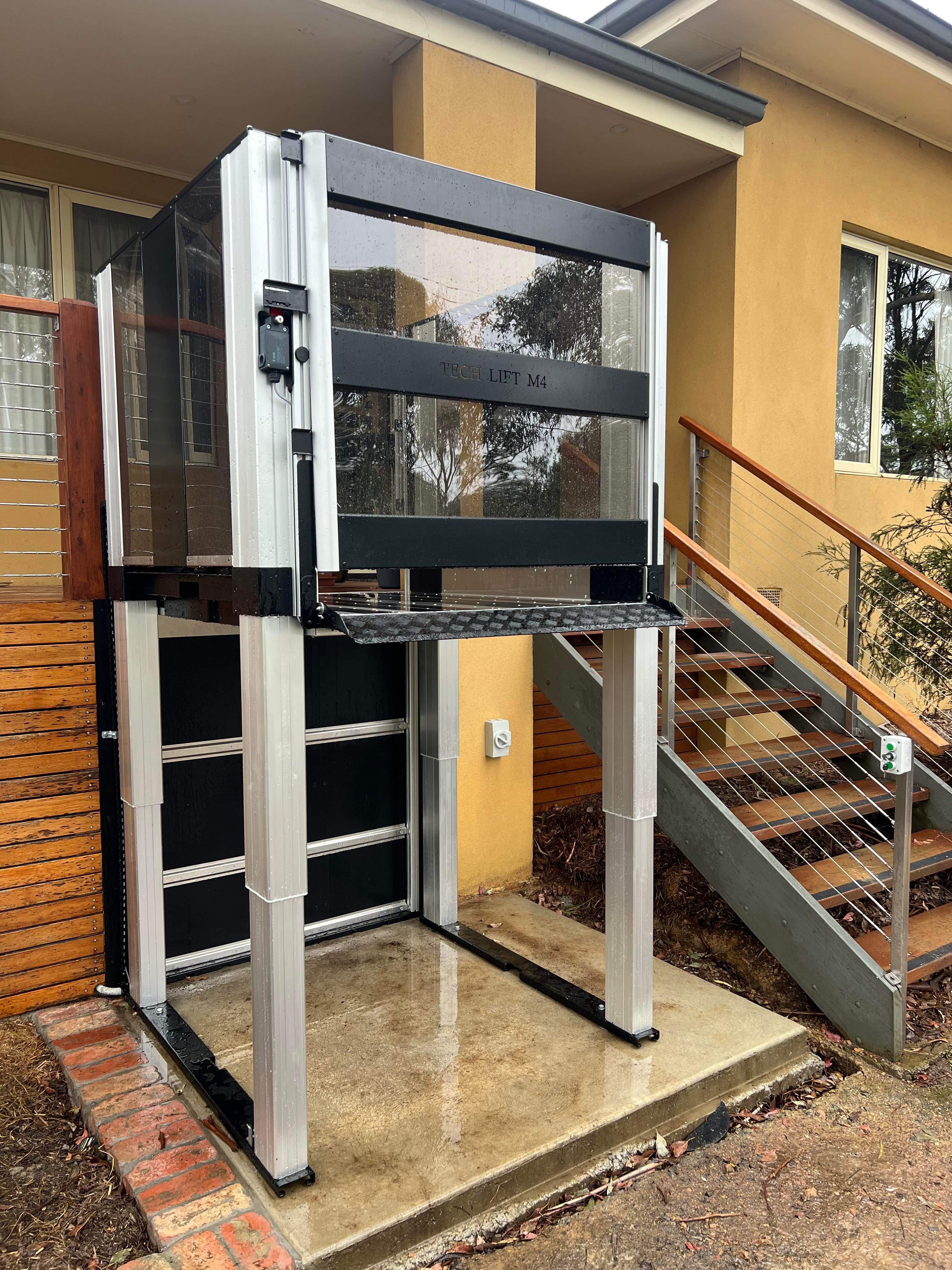
A low-rise platform lift is a small vertical lift that carries a person, wheelchair or mobility scooter on a platform over a short change of level. Our Low-Rise Series covers travel of up to 1.5 metres and a rated load of up to 340 kilograms, indoors or outdoors, in open or enclosed types.
You will also hear them called vertical platform lifts, VPLs or wheelchair platform lifts. Rather than a full cabin running in a shaft, the user rides a platform with gates or barriers at the landings. That keeps the lift compact and the building work small.
The Low-Rise has no-pit options, so on an existing slab it can often sit on the surface, and lead times are short. We source the range from global suppliers able to meet BCA and DDA compliance, and it is specified to AS1735.14 and AS1735.15. The brochure on the Low-Rise page shows models that surface mount straight onto a concrete pad or timber floor, or sit in a shallow pit for level access.
Where do low-rise platform lifts suit?
A low-rise platform lift suits a short change of level that a ramp cannot handle well: the steps up to a front door or shop entrance, a porch or deck, a stage, a mezzanine landing, or a split level inside a house, club, school or office. If the rise is more than 1.5 metres, look at a full lift.
At home, the usual job is the front or back steps, or a sunken room or split level that has become hard to cross in a wheelchair. In a building open to the public, it is often the entrance stairs, a raised stage in a hall, or a change of level between two parts of the same floor.
Because the Low-Rise comes in indoor and outdoor versions, steps outside the building are often workable. Outdoors, think about the surface the lift will stand on and the path to and from each landing, as well as the lift itself.
What should you check before choosing one?
Check five things first: how far the platform has to travel, how much floor space is free at the top and bottom, where power will come from, who will use the lift, and what access the building has to provide. Those answers usually settle the model and the type of platform before anything else.
- Travel. Measure from the lower floor or ground to the upper landing. The Low-Rise covers up to 1.5 metres, and anything higher, or more than two levels, needs a full lift.
- Footprint and approach. Check the floor area free where the lift will stand, and the clear space in front of each landing for someone to roll on and off. The models in the Low-Rise brochure can set entry, exit and control positions to suit the site.
- Floor and pit. Work out whether the platform can sit on the existing slab or deck. The Low-Rise has no-pit options, which matters on an existing slab.
- Power. Your project manager confirms the power supply needed for the model chosen, and where it will come from.
- Finishes. Choose between an open and an enclosed platform, and think about how the gates, walls and any glass will look against the building. The brochure lists a silver grey and aluminium finish with black trim, a glass panel option and other finishes.
- Who uses it. Think about wheelchairs, mobility scooters, carers and anyone else who will ride the platform. Users set the platform size and load the lift needs, so put them in the brief from the start.
- Access requirements. In a building open to the public, the lift is part of how the building meets its access obligations under the DDA, the Premises Standards and the National Construction Code. Your building surveyor or certifier confirms compliance for the site.
How does a platform lift compare with a home lift or a Mariner DDA?
A platform lift is for one short rise. A passenger home lift or a Mariner DDA moves people between full floors in an enclosed car, across several levels. If the change of level is a few steps, a platform lift is the smaller job. If it is a whole storey or more, it is the wrong tool.
The Mariner DDA is our lift for public and commercial buildings with several levels. It is built in Australia to AS1735.16, serves up to four levels with up to 8 metres of travel and takes up to 630 kilograms, with room for wheelchairs and mobility scooters. It needs a 100 millimetre pit and 2350 millimetres of headroom measured above the first-floor landing, and on an internal install it needs no overhead space and no load-bearing walls.
For a private home that needs a lift between full storeys, start with our residential lifts. The SWIFT Pro travels up to 12 metres with a 50 millimetre pit. The Australian-made Phoenix travels up to 8 metres and is self supporting, so no structural modifications to the house are needed. It is the Mariner DDA built for residences, without the DDA extras of a returned handrail and dual control operating panel.
In commercial buildings, schools and factories, the Orion in our commercial range is the other multi-level option, with up to 630 kilograms and 8 metres of travel, installed without load-bearing walls. If an old lift is already in the building, retrofit and replacement can often fit the existing shaft without major structural changes. Our guide to DDA compliant lifts covers how the whole accessible range fits different buildings.
| Model | Max travel | Rated load | Pit |
|---|---|---|---|
| Low-Rise Series | 1.5m | up to 340kg | No-pit options |
| Mariner DDA | 8m | up to 630kg | 100mm |
| Phoenix | 8m | up to 630kg | 100mm |
| SWIFT Pro | 12m | up to 400kg | 50mm |
Figures are maximums, from each model's page: Low-Rise, Mariner DDA, Phoenix and SWIFT Pro.
Should you hire or buy a platform lift?
Buy a permanent platform lift when the building needs step-free access every day. Hire one when access is needed for an event, a season or the months before a permanent lift goes in. For hire, the Mobilift is a manually operated portable wheelchair platform with up to 1.5 metres of travel that sets up in under five minutes.
The Mobilift takes up to 275 kilograms and is available for short or long term hire. It is operated by hand, so it needs no power point and works outdoors. At the AFL Big Freeze in Melbourne it gave wheelchair users access from the concourse to field level. Our guide to Mobilift hire explains how hire works.
How often does a platform lift need servicing?
A platform lift is still a lift, and it needs regular servicing to stay safe and reliable. For servicing, we recommend six monthly services for residential lifts, and quarterly servicing for public lifts. Southern Lifts services the lifts we install, with our own technicians, so servicing can be planned before the lift is handed over.
Our maintenance agreements come in three levels: Compliance, Standard and Comprehensive, with 24/7 emergency call-out from Southern Lifts technicians. For NDIS questions, see our NDIS page; this guide does not cover funding.
Next steps
The first consultation is free, at our showroom at 2/226 Governor Rd, Braeside VIC 3195 or on site. A Low-Rise platform and a Phoenix are installed and running there, so in one visit you can try a platform lift with your own wheelchair or scooter and get the feel of a Mariner DDA. We are open Monday to Friday 7:00–4:30, with Saturdays by appointment.
We work on homes and buildings across Melbourne and Geelong. Bring a measurement of the rise, a photo of where the lift will go and a note of who will use it. To start, contact Southern Lifts or call 1300 580 000.
Questions about low-rise platform lifts
How high can a low-rise platform lift go?
Our Low-Rise Series covers up to 1.5 metres of travel, with a rated load of up to 340 kilograms. For a bigger rise or several levels, look at the Mariner DDA, which travels up to 8 metres.
Does a platform lift need a pit?
Not always. The Low-Rise has no-pit options, so it can often sit on an existing slab or deck. We confirm what suits your site at the consultation.
Can a platform lift go outside?
Yes. The Low-Rise comes in indoor and outdoor versions, in open or enclosed types, so the steps outside a house or building are often workable.
Can I try a platform lift before I decide?
Yes. A Low-Rise platform is installed and running in our Braeside showroom. Bring the wheelchair or scooter and book a visit. We are open Monday to Friday 7:00–4:30, with Saturdays by appointment.
Pages that go further
- Low-Rise platform liftUp to 1.5 metres of travel, indoors or out, with no-pit options.
- Disabled access liftsMariner DDA, the Low-Rise platform and Mobilift hire.
- Mariner DDAIndependent access across multiple levels, to AS1735.16.
- MobiliftA portable platform for events and temporary access.
- DDA compliant lifts guidePlatform lifts and full lifts for accessible buildings.
- Mobilift hire guideHow short and long term hire works.
- Commercial liftsThe Orion and the rest of the commercial range.
- Residential liftsSWIFT Pro, SWIFT Lite, Phoenix and InDomo, side by side.
- MaintenanceCompliance, Standard or Comprehensive, plus 24/7 call-out.
- Lifts in MelbourneThe Braeside showroom and the Melbourne jobs on this site.
- Get adviceFree, in the Braeside showroom or on site.
Get advice on a platform lift
Tell us the height of the rise, where the lift will stand and who will use it, and we will tell you what suits. Call 1300 580 000 or send an enquiry.