
Buying guide · 16 November 2026
Home lift
vs stairlift
A stairlift is a seat on a rail that follows the staircase: you transfer onto it, ride along the stairs and transfer off at the other end. A home lift is a small car that travels straight up between floors, and you step or wheel into it. For speed, convenience and how it looks in the house, a home lift is the better choice. Compact drive systems have also made the footprint much smaller than earlier home lifts, so a lift is practical in more homes than it used to be. Southern Lifts designs, installs and services home lifts and platform lifts from our Braeside showroom in Melbourne. To talk it through for your house, book a free consultation.
The short answer
A home lift is the better choice. It is quicker to use, because you walk or wheel straight in with no transfer onto a seat. It is more convenient, because the shopping, the washing basket or a carer can ride along. And it looks like part of the house, not equipment fixed to the stairs.
The usual objection was space, and compact drives have largely answered it. There is more on that below, along with a platform lift for short rises.
Why a home lift wins: speed, convenience and looks
Speed. A home lift goes straight up between floors. You walk or wheel in, press a button and step out on the next level. There is no transfer onto a seat and off again, which is the slow part of riding a stairlift. SWIFT travels at up to 0.3 metres per second, and the speed can be adjusted to suit the user.
Convenience. Nobody has to manage a transfer, so the lift keeps working as mobility changes. A carer, the shopping or the washing basket can travel too, and the staircase is left clear.
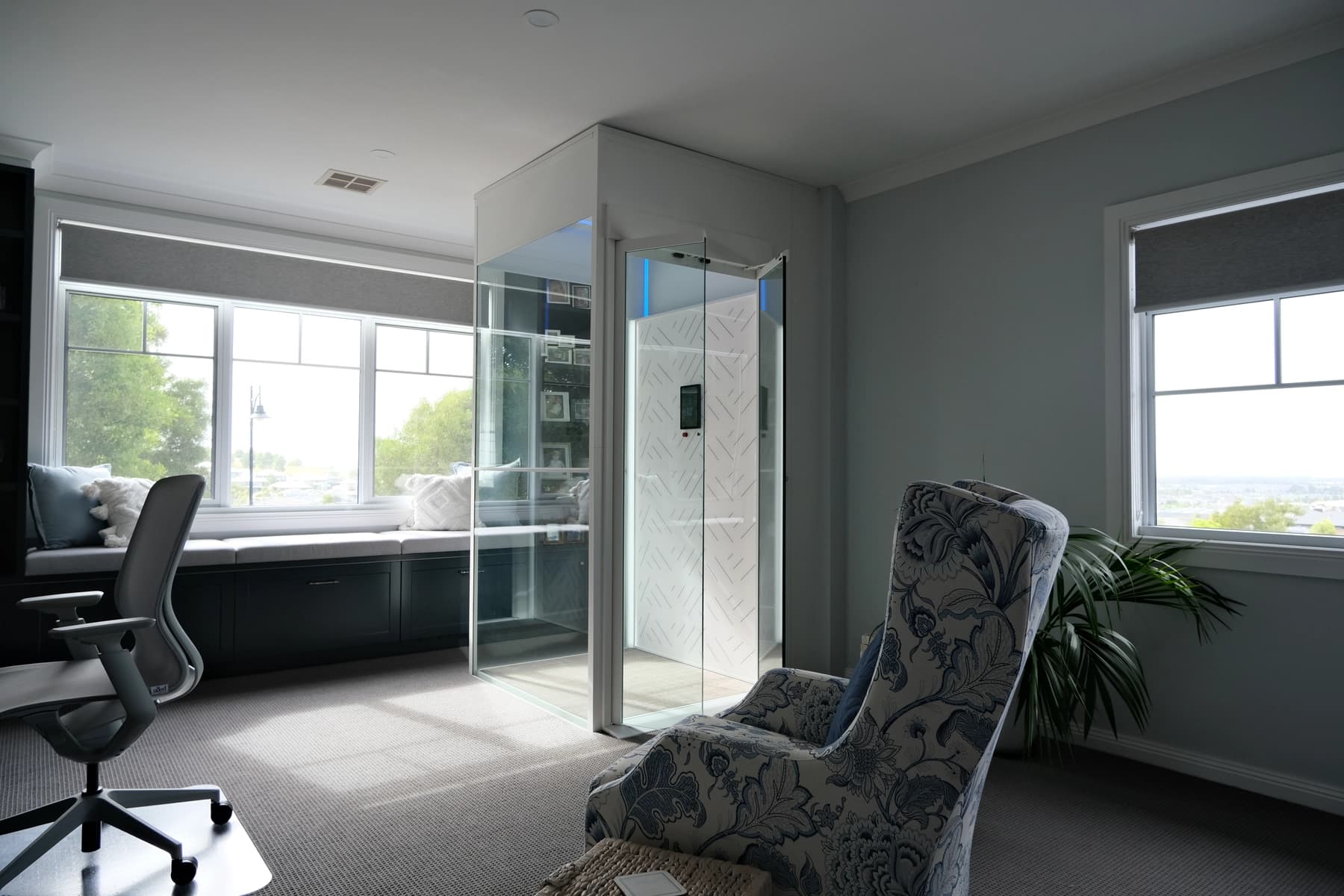
Looks. A stairlift is a rail and a seat on the staircase, and it reads as mobility equipment. A home lift is designed into the house, with the car finished like a room, a feature of the home rather than an add-on.
Smaller than home lifts used to be
For a long time, space was the reason people looked at a stairlift instead: a lift meant finding room for a shaft. Compact drive systems like the SWIFT screw and nut drive mean the required footprint can be much smaller than earlier home lifts.
With the SWIFT XXS, the required footprint can be as low as 940 by 1025 millimetres. That is the recommended floor opening, the hole through the floor, not the car size. The XXS car itself is 830 by 600 millimetres, rated for 250 kilograms or two people, and it is available on both SWIFT Pro and SWIFT Lite.
The rest of the install stays small too. SWIFT is battery driven, needs 0 to 50 millimetres of pit and 2250 millimetres of headroom, and has no external machine room. There are six car sizes, up to 400 kilograms or five people, so the car can be sized for a wheelchair where it needs to be.
The space guide has the floor opening for every SWIFT size, and the SWIFT page covers the range.
Home lift vs stairlift side by side
Stairlifts vary from product to product, so that column sticks to how they generally work.
| Question | Stairlift | Home lift |
|---|---|---|
| Who it suits | Someone who can walk on each floor and still transfer safely to and from a seat | Anyone who can step or wheel in, including people who can no longer manage a transfer |
| Wheelchair use | Usually not suitable if the user needs to stay in the wheelchair | Yes, when the car is sized for the chair, so it belongs in the brief from the start |
| Floors | Follows one staircase; curved or turning stairs need a custom rail | Up to about four levels on most of our home models, including a garage or basement |
| Space and building work | No floor opening, but the rail takes space on the stairs | A floor opening from 940 × 1025 mm with the SWIFT XXS, on a 0 to 50 mm pit |
| Shopping, laundry or a carer | Carries one seated person | SWIFT sizes are rated for two to five people, so bags, a basket or a carer can ride along |
| How it looks | A rail and a seat on the staircase | Designed into the house, with the car finished like a room and the stairs left clear |
| Future-proofing | Works only while the user can still manage the seat | Keeps working if mobility changes, and the whole household can use it |
| Resale and appeal | Generally seen as mobility equipment | Can be specified as a feature of the house |
Home lift details come from our residential range and the SWIFT model pages.
When a home lift is the better fit
People often start looking at a stairlift when there is one flight of stairs and the user can still manage a transfer today. Even then, a compact home lift is usually the better long-term answer, because it does not depend on that transfer. It is the clear choice when:
- A wheelchair user needs to stay in the chair. A home lift can carry a wheelchair user when the car is big enough, so tell us at the start; it sets the minimum car size.
- Transfers are getting harder. When getting onto a seat is becoming the risk, a lift you walk or wheel straight into takes that step away.
- The house has more than two levels. SWIFT Pro, SWIFT Lite and InDomo travel up to 12 metres, about four levels. Phoenix travels up to 8 metres.
- Someone travels with the user. SWIFT sizes are rated for two to five people, up to 400 kilograms in the two largest, so a carer, the shopping or the washing basket can come too.
- You are building or renovating anyway. The Deanside display home SWIFT Pro was specified as a future-proofing feature, designed in from the start.
The middle option for short rises
Not every change of level is a full storey. For the steps up to the front door, a porch or a split level, a platform lift is usually simpler than a full home lift.
The Low-Rise platform lift covers up to 1.5 metres of travel, indoors or out, with no-pit options and short lead times. One is running in our Braeside showroom, so you can take a wheelchair or a scooter onto it before you decide.
The disabled access range also includes the Mobilift, a portable platform that venues hire for temporary access rather than one for a house.
Space and structure
Beyond the floor opening, a home lift needs a little pit and some headroom. Phoenix is self-supporting, so no structural modifications to the home are needed. InDomo fits under a 2.4 metre ceiling, with custom car sizing for an awkward opening.
If the house is already built, read can you install a home lift in an existing home in Melbourne and our retrofit page. An InDomo in a stairwell void shows a lift fitted into the only space a house had.
What affects the cost
We do not publish prices. A home lift quote depends on the model, the number of levels, the pit and headroom the house can give, new build or retrofit, the finishes, the installation, and servicing afterwards. The home lift cost guide works through each one.
Budget for servicing from day one: we recommend six monthly services for residential lifts, and quarterly servicing for public lifts, under a maintenance agreement.
If you are exploring support through the NDIS, start with our NDIS page. We prepare the quotes, drawings and specifications, and the NDIA makes the funding decision.
Next steps
The quickest way to decide is to stand in one. A SWIFT Pro, an InDomo and a Low-Rise platform are running at our showroom at 2/226 Governor Rd, Braeside. We are open Monday to Friday 7:00–4:30, with Saturdays by appointment.
The first consultation is free, in the showroom or at your property. If an occupational therapist is involved, we are happy to meet them on site.
We look after homes across Melbourne and Geelong. To start, contact Southern Lifts or call 1300 580 000.
Questions about home lifts and stairlifts
Is a home lift better than a stairlift?
For most homes, yes. A home lift is quicker to use, carries a wheelchair user, a carer or the shopping, and is designed into the house instead of fixed to the stairs. Compact drives mean it needs much less room than earlier home lifts: the SWIFT XXS needs a recommended floor opening of 940 by 1025 millimetres. Book a free consultation.
Can a wheelchair user use a stairlift?
Usually not while staying in the chair, because a stairlift carries a seated person on a rail. For wheelchair access between floors, look at a home lift with a car sized for the chair, or the Low-Rise platform lift for a rise of up to 1.5 metres.
What are the alternatives to a stairlift?
A home lift between floors, or a platform lift for a short rise. In our range that means the SWIFT Pro, SWIFT Lite, Phoenix and InDomo home lifts, and the Low-Rise platform lift.
What is the difference between a stair lift and an elevator?
A stairlift moves a seated person along the staircase. A home lift, sometimes called a home elevator, carries a car straight up between floors, with no transfer onto a seat, and the stairs are left clear.
Does a home lift need a lot of building work?
Often less than people expect. The SWIFT XXS needs a recommended floor opening of 940 by 1025 millimetres, SWIFT needs 0 to 50 millimetres of pit and no external machine room, and Phoenix is self-supporting. The space guide has the figures for each model.
Can I try a home lift before deciding?
Yes. A SWIFT Pro, an InDomo and a Low-Rise platform are running at our Braeside showroom. Book a visit or call 1300 580 000.
Pages that go further
- Residential liftsSWIFT Pro, SWIFT Lite, Phoenix and InDomo, side by side.
- SWIFTThe Swedish battery-driven range with a 0 to 50 millimetre pit.
- Low-Rise platform liftUp to 1.5 metres of travel, indoors or out, with no-pit options.
- Retrofit and replacementExisting houses, and shafts that are already there.
- Home lift space guideFloor openings, pit, headroom and travel for each model.
- Home lift cost guideWhat moves a home lift quote, from pit depth to servicing.
- MaintenanceCompliance, Standard or Comprehensive, plus 24/7 call-out.
- Home lifts in MelbourneThe Braeside showroom and the Melbourne jobs on this site.
- Book a consultationFree, in the Braeside showroom or at your property.
Get a quote for your house
Free consultation in the Braeside showroom or at your property. 2/226 Governor Rd, Braeside VIC 3195. 1300 580 000.